Showing posts with label News. Show all posts

Wednesday, February 24, 2010

Fun Facts: How Small is 32 Nanometers?

E
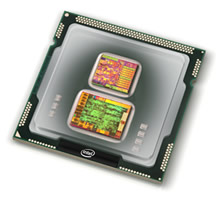
arlier this year Intel made a big splash with a new generation of Core i3 and Core i5 processors using the uber small 32 nanometer manufacturing process. Although this is eventually going to get dumped as ancient technology for an even smaller and more efficient way to produce chips, today it's state of the art.

Intel recently published a whitepaper with some amusing 32nm facts that we are reproducing here for you. If you have ever wondered how small the logic inside these chips really is in 'measurable' terms, here are some random facts to give you some perspective:
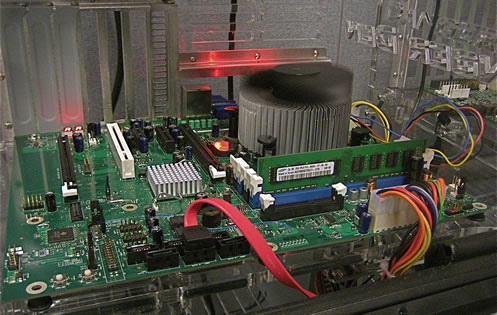

  • A nanometer is so small that it takes a billion of them to make a meter. A billion is a huge number. A stack of a billion sheets of paper would be 100 km high. If you could walk a billion steps, you would go around the earth 20 times.


  • The original transistor built by Bell Labs in 1947 was large enough that it was pieced together by hand. By contrast, more than 60 million 32nm transistors could fit onto the head of a pin.


  • More than 4 million 32nm transistors could fit in the period at the end of this sentence.


  • A 32nm transistor contains gates that are so small, you could fit 3,000 of them across the width of a human hair.


  • A 32nm transistor can switch on and off over 300 billion times in one second. It would take you 4000 years to flick a light switch on and off that many times.


  • Compared to Intel’s first microprocessor, the 4004, introduced in 1971, a 32nm CPU runs over 4000 times as fast and each transistor uses about 4000 times less energy. The price per transistor has dropped by a factor of about 100,000.


  • The “World’s Fastest Man,” Usain Bolt would have to take 3,125,000,000 steps in the 100 meter dash if his stride length was 32nm.


  • If the pace of innovation in space travel had increased at the pace of Moore’s Law since 1971, you would now be able to travel at the speed of light, 671 million miles per hour.


  • Intel has shipped over 200 million CPUs using high-k/metal-gate transistors – the kind used in 32nm processors -- since the technology was first put into production in November 2007. This translates to over 50,000,000,000,000,000 (50 quadrillion) transistors, or the equivalent of over 7 million transistors for every man, woman and child on earth.


  • The price per transistor on a chip has dropped dramatically since Intel was founded in 1968. Some people estimate that the price of a transistor is now about the same as that of one printed newspaper character.


  • Read more...

    Microsoft, Amazon ink cross-licensing agreement

    M
    icrosoft and Amazon have inked a new cross-licensing agreement that gives the companies access to some of each other's patents. Details are limited, but Microsoft mentioned that Amazon's Kindle e-reader and the shopping giant's use of Linux-based servers are included. Microsoft didn't specify what intellectual properties it would share with Amazon.

    Along with the licensing arrangement, it's said that Amazon will pay Microsoft a chunk of money, but the companies didn't say how much. In fact, the motive behind the deal itself is undisclosed. Some suggest Amazon agreed to the terms to avoid a patent-infringement suit from Microsoft. Other companies that use Linux have signed patent deals, and Redmond has repeatedly claimed the software violates some of its patents.


    About a year ago, Microsoft sued TomTom over eight patents -- including three related to the GPS-maker's implementation of the Linux kernel. ITIC principal Laura DiDio noted, "It makes more sense for companies to make nice and do a cross-licensing agreement -- Microsoft has come to realize that legal action is often more costly than it is worth."

    Microsoft has entered more than 600 licensing agreements since the company launched its IP licensing program in December 2003.

    Read more...

    Tuesday, February 23, 2010

    High school uses notebook webcams to spy on students

    T
    he parents of a Lower Merion high school student have filed suit against the district for using school-issued laptops to spy on kids. The school rigged notebooks with software that lets officials remotely view and capture images with the built-in camera -- a mechanism that was supposedly greatly misused. The plaintiff's child claims to have been disciplined in school for "improper behavior" at home, and the Vice Principal used a photo taken by the webcam as evidence.

    In a statement yesterday, Superintendant Dr. Christopher McGinley confirmed that the laptops indeed have a "security feature" to track missing systems. The "feature" can take a "still image of the operator and the operator's screen," but McGinley said it has been deactivated, and will not be reactivated without express written notification. He also insisted that the feature has only been used to locate lost, stolen or missing laptops.

    Students involved in the suit have contacted Gizmodo with details about the situation. It's said that the green lights next to the kids' laptops often turns on, suggesting it's in use, but the district claims it's just a glitch. One student questioned a school IT guy about the light, who said it was occurring because "people logged out when an application using the camera was on." The employee also admitted that the school could in fact look through the webcam, but it would violate law.

    Read more...

    Nvidia Ion 2 slower than the original Ion?

    A
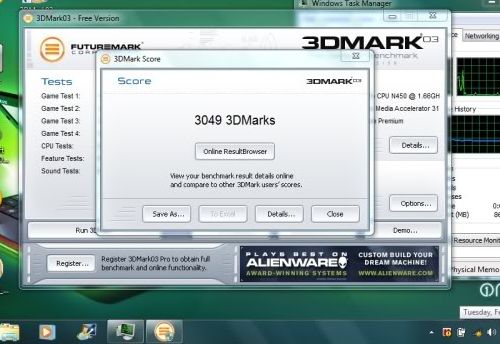
    cer last week announced its Aspire One 532G netbook as the first to carry Nvidia's forthcoming Ion 2, but few details have been revealed about the next-gen graphics chip. Some folks at NetbookNews recently got their hands on the Aspire One 532G at Mobile World Congress, and they managed to sneak in a 3DMark 03 graphics benchmark.

    While the results aren't conclusive, the Ion 2 actually performed worse than the original. The Aspire One 532G scored 3,049 3DMarks, which compares to 3,593 3DMarks for the Ion LE-equipped Samsung N510. Netbook Choice speculates that this may show issues Nvidia has faced with Intel's Pine Trail architecture.


    Since the GPU-maker isn't allowed to create chipsets around DMI, the Ion 2 likely uses PCIe to interface with Pine Trail. It's suggested that limited bandwidth over PCIe could be the culprit -- at least partially -- but there are other explanations. For instance, Acer and Nvida might have crippled the system to keep it stable while being shown at MWC. Unpolished drivers could also be responsible.

    An Nvidia representative quickly responded to the unflattering benchmark results: "I can’t vouch for the accuracy of the benchmark that was performed at that show. I believe the units there were pre-release systems. We haven’t provided performance data yet for the public, we’ll have more details coming in early March."

    Read more...

    Friday, October 16, 2009

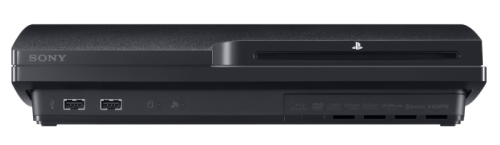
    Gaming Sony announces 250GB PlayStation 3, due November 3

    F
    ollowing the successful launch of a slimmer PlayStation 3 model back in September, Sony has announced a beefier 250GB variant of the console is due to hit U.S. stores next month priced at $350. Besides upping storage capacity
    , the new system will be otherwise identical to the existing 120GB version which sells for $50 less.


    The move comes as expected after leaks suggesting a larger-capacity PS3 would arrive sometime in October. Contrary to some rumors, however, for now the 250GB console has not been announced as part of any bundle like we've seen elsewhere -- Japan will be getting a Final Fantasy XIII bundle in December, for example, while customers in Europe can now get the new 250GB model packed alongside Naughty Dog's Uncharted 2. Hopefully Sony will announce a similar deal for U.S. customers in time for the holiday season.

    Those who recently bought the 120GB version, and PS3 owners in general, might be interested to know that you can also swap out the 2.5-inch SATA drive yourself without voiding the warranty on your PlayStation 3. A quick search online shows that a 320GB hard disk drive can be had for around $56 and a 400GB model for $70, so you'll have to pay a little a premium assuming you even need more storage capacity.

    Read more...

    Wednesday, September 9, 2009

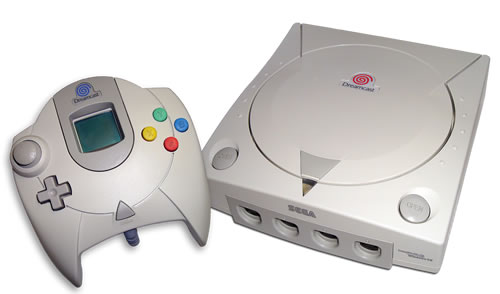
    Pioneer console Sega Dreamcast turns 10

    C
    onsoles have come a long way in a short time, evolving alongside computers as one of the center pieces for video game entertainment. As the line between computer and console begins to blur, it's easy to forget just how far the console has journeyed. A good reminder of that came this week, when the Sega Dreamcast turned ten years old.

    The much-hyped console was highly anticipated by gaming communities all over the world, but it ended up proving to be a disaster for Sega as a company, as it was their last console endeavor. Even though it was a commercial failure, the console pioneered many of the ideas that are common among modern consoles.


    The idea of an Internet-connected gaming console was first realized with the Dreamcast, which came stock with a built-in dial-up modem and featured one of the first console web browsers. Along with the PC, it was one of a very few hardware devices that allowed people to play games with each other online. The Dreamcast also had a controller design that is suspiciously similar to the Xbox 360's -- though that may be just a coincidence.

    Though other consoles quickly surpassed the Dreamcast, including the current most popular console in the world (PlayStation 2), it was an example of high technology at the time and is curious to look back on.

    Read more...

    Russia drops Microsoft antitrust probe over Windows XP

    R
    ussia's competition regulator, the Federal Antimonopoly Service (FAS), has dropped a probe launched against Microsoft back in June over alleged violations to the country's laws. The agency had accused Redmond of having unfair pricing policies and restricting Windows XP sales to retailers and OEMs, even though there was continued demand for the older operating system, forcing customers to use Vista instead.

    As noted in our previous coverage, Microsoft is obviously keen to move customers on to its newest operating systems not just to increase sales but also to reduce support costs. Despite this the company reportedly supplied evidence to the FAS that XP was in fact still available and that it had sold over a million Russian language copies of the operating system in fiscal 2008 (which ended on June 30, 2008).

    As part of the agreement to drop the case, Microsoft said it will give Russian users the option of exchanging their copies of Vista Home Basic or Home Premium for Windows XP Home, free of charge. The exchange program will kick off in the next three weeks and will last until the end of 2009.

    Read more...

    Apple updates iPod lineup, nano gets video camera

    A
    s expected, Apple unveiled new iPod models across the board today which bring added functionality and lower prices. A recovered Steve Jobs took the stage for the first time in almost a year to announce that over 225 million iPods have been sold since its introduction in 2001, with the iPod touch representing 20 million of that number and contributing to an overwhelming 74% market share.


    Starting at the high end, Apple touted an update to the iPod touch line that will see it packing the same processing platform as the recently introduced iPhone 3GS -- meaning they now support improved graphics with Open GL ES 2.0. This is true for both the 32 and new 64GB models, priced at $299 and $399 respectively, while the last-gen 8GB iPod touch will remain available for just $199. There doesn't appear to be a built-in camera, however, contrary to all the rumors.

    Moving on the iPod classic was updated with a 160GB HDD but kept its $249 price tag. On the other end of the spectrum, the shuffles are now at $59 for 2GB, $79 for 4GB and come in black, silver, pink, green and blue. There's also a polished aluminum 4GB version for $99.


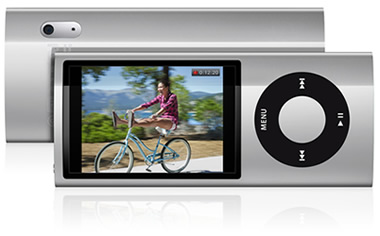
    Last but not least, Apple's iPod nano got a revamp and is now available in capacities up to 16GB. Its design remains mostly unchanged from the previous model, if not for the larger 2.2-inch display, but gains a built-in camera and mic for recording 640 by 480 pixels, 30 FPS video -- apparently it does not take still photos. After years of dismissing the feature, Apple has also added an FM radio tuner to the nano, as well as pedometer and voice over functionality. The 8GB iPod nano is priced at $149 while the 16GB model goes for $179.

    Read more...

    Tuesday, September 8, 2009

    Intel Core i5 750 Processor Review

    I
    t has been 10 months since Intel unleashed its Nehalem architecture and we showed you the Core i7 920, 940 and 965 Extreme Edition. Not much has changed in the high-end sector during this timeframe, as Core i7 processors are still brutally fast and equally expensive.

    The new Intel Core i5 750 is the first release in a series of processors based on a mainstream version of the Core i7 platform. It is a quad-core part based on the "Lynnfield" architecture, fabricated using a 45nm process and utilizing the new LGA1156 platform. The Core i5 750 is set to cost just $199, it will operate at a healthy 2.66GHz and feature a whopping 8MB L3 cache, but no Hyper-Threading support will be present.


    In our review we will go into more detail about Intel's reworked desktop CPU line-up, the new P55 chipset (LGA1156), and our usual load of benchmarks comparing this new processor against current Core 2 Quad offerings, the Core i7 920 and the AMD Athlon II X4 965.

    Read more...

    Zero-day Windows Vista, 7 vulnerability discovered

    M
    icrosoft is looking into a zero-day vulnerability today, which reportedly affects systems running Windows Vista and 7. Researcher Laurent Gaffie said that a hacker could exploit the flaw on Windows 7 to cause a critical system error. The flaw lies in a Server Message Block 2 (SMB2) driver.

    Gaffie said in a blog post yesterday, "SRV2.SYS fails to handle malformed SMB headers for the NEGOTIATE PROTOCOL REQUEST functionality." People who have commented on his blog post are reporting that the exploit can not only lead to denial of service, but also remote code execution.


    Gaffie has contacted Microsoft, and it has since responded by saying that it is investigating the issue but that it is "unaware of any attacks trying to use the claimed vulnerability or of customer impact." The H has successfully tested the proof-of-concept code, which caused a reboot on Vista -- but did not work on Windows 7.

    Read more...

    Firefox 3.6 to arrive this year, 4.0 in late 2010

    A
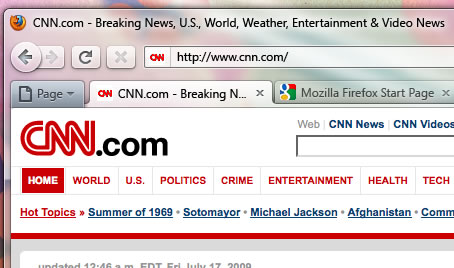
    lthough Mozilla released Firefox version 3.5 not long ago, the team has been showing mockups of future designs. In addition to embracing glass on Windows Vista and 7, future versions will have reorganized interfaces. Previews of Firefox 4.0 suggest that it may have a combined and relocated reload, stop and go buttons, as well as a tab sidebar, tabs on top, and many other UI tweaks -- none of which are set in stone.


    Mozilla is now indicating that we may see the launch of Firefox 4.0 next October or November. It has also reportedly updated its roadmap for the release of Firefox 3.6 and 3.7, with the former expected to debut later this year and the latter to arrive in the second quarter of next year. There are also reports that Fennec 1.0 -- the mobile version of Firefox -- will be made available at the same time as Firefox 3.6, and Fennec 2.0 with Firefox 4.0.

    If the suspense is killing you, fear not; pre-release builds are available. Feel free to download Firefox 3.6 and 3.7 at your own risk.

    Read more...

    Worm attacks WordPress blog software

    S
    erving as a stern reminder of why it's important to keep desktop as well as server software up to date, a new worm can reportedly infect certain versions of the WordPress blog software. WordPress announced the discovery today, saying that a security bug which has already been fixed is now being exploited in the wild.

    The worm is able to attack versions of WordPress prior to 2.8.4 and its immediate predecessor. Version 2.8.4 was released in early August to specifically address this flaw, which results in a password reset of WordPress accounts and allows someone to take control of the admin account. Doing so would give the person access to further information, as well as the ability to wreak havoc on the blog itself.

    Though the vulnerability was initially published several weeks ago, this is the first report of malware specifically identifying and trying to exploit it. The WordPress developer is concerned that many servers are still running old versions, which puts them at risk. If you're maintaining a WordPress server that's behind on updates, consider this a heads up.

    Read more...

    Monday, September 7, 2009

    Samsung hopes to launch OLED laptops next year

    S
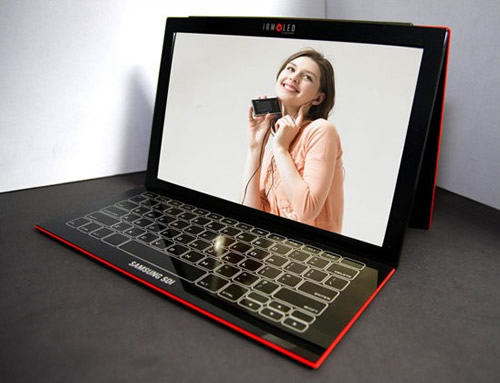
    amsung is hoping to launch OLED-equipped laptops by the third quarter of next year. According the company's head of worldwide sales and marketing, Kyu Uhm, Samsung is the largest OLED screen manufacturer. Uhm added that Samsung will adopt OLED displays as soon as they are commercially available for laptops.

    Research firm Gartner believes that mainstream OLED notebooks will have an increasing presence over the next five years. Samsung is surely sold on the technology, having already shown off an AMOLED notebook prototype. Introducing an OLED laptop toward the end of 2010 woul


    In October of 2007, the company said it planned to have 3.5" to 7" panels prepared for ultra-portable systems in 2008, which would be followed by 14", 15", and 21" displays for laptop and desktop computers in 2009. It predicted that it would have full 40" and 42" HD OLED panels by 2010 and Flexible OLED (FOLED) displays by 2012 at the latest.

    Read more...

    Toshiba announces Blu-ray-equipped Satellite P500

    T
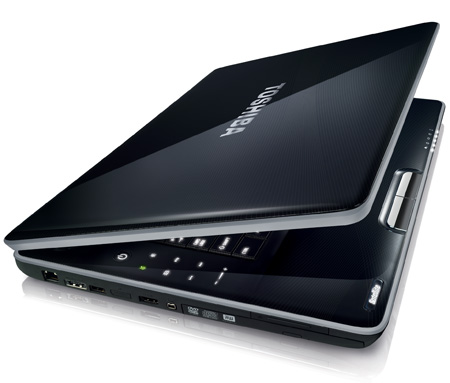
    oshiba has announced its new media-centric notebook, the Satellite P500. The Satellite P500 features an 18.4" 16:9 (1680x945 or 1920x1080) LCD display, an Intel Core 2 Duo, up to 8GB of DDR2 RAM, an Nvidia GeForce G210M (512MB VRAM) or 230M GT (1GB VRAM), and two 500GB HDDs.

    Equipped with a Blu-ray drive and focused on entertainment, the P500 ships with more than just the expected trimmings. Additional specs include a TV tuner card, VGA and HDMI-out, a remote control, 802.11a/b/g/n, an HD webcam, Bluetooth 2.1 + EDR, three USB 2.0 as well as Firewire and eSATA ports, S/PDIF digital audio interfacing, an Express Card slot, a 5-in-1 Bridge Media port, and Harmon Kardon speakers.


    Toshiba boasts that the Satellite P500 is Energy Star 5.0 certified -- but that seems moot with an 18.4" display, an Nvidia G210/230M GT and dual HDDs. The P500 will hit shelves in the fourth quarter of this year, which likely means you can expect to see Windows 7 installed. Pricing wasn't disclosed. Catch a video after the jump.

    Read more...

    Thursday, September 3, 2009

    Philips announces pricey Wireless HDMI solution

    C

    omputer and gadget lovers like us are no strangers to the rat's nest of hanging cables that usually forms behind our desks. But this isn't the only place where electronic components are wired together; more and more our living rooms have morphed into media centers with at least a mid-sized TV, several audio / video components and typically a gaming console.
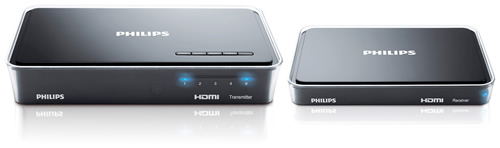
    Fortunately there has been some development aimed at wirelessly connecting HDTVs to our entertainment setups, particularly with Wireless HDMI and WirelessHD. The bad news: it's expensive and not entirely practical for now. Nevertheless, looking to gain an early foothold on the market, Philips has announced a pair of Wireless HDMI boxes which aim to let users connect audio and video devices to their TVs without all the clutter.


    The Wireless HDTV link will let you relocate or even hide your components up to 20 meters away while still sending a 1080p/30 HD signal. But getting rid of wires will come at the cost of adding two separate boxes; the image source (Blu-ray player, for example) is connected to a transmitter box and the TV or projector is connected to a smaller receiver box. 
    This setup makes more sense if the two devices are not located next to each other, but eventually Wireless HDMI technology will be built into home electronic products -- thus obviating the need for transmitter and receiver boxes. Phillips' solution includes two digital HDMI connections, two component connections, and a hefty 600 Euro ($850) price tag.

    Read more...

    YouTube to offer movie rentals for $4?


    Still trying to turn lucrative, YouTube is reportedly working on a movie rental service. The online video sharing site has been almost entirely reliant on user-submitted content, but it is in talks with various film studios about securing licenses to host motion pictures. Among the names in the discussion are Sony Pictures, Lions Gate Entertainment Corp., and Warner Bros. Studios.


    Speculation has it that while some movies will be viewable for free on an ad-supported basis, others will cost $4 to rent. This shouldn't come as a surprise as YouTube has been working to catalog more premium content. Turning to feature films may bring Google a welcomed profit, having failed thus far to earn a buck off their $1.65 billion investment.
    I get the feeling that many people will condemn the thought of YouTube offering paid content. With a slogan like "Broadcast Yourself," it's easy to call YouTube a sellout and think that it's becoming a little less about you, and a little more about pushing mainstream media. I ask you, though, if the current system remains unaffected, is there really a problem?

    Read more...

    OnLive cloud-based gaming service now in public beta

    O
    nLive's cloud-based gaming service has just rolled into open beta, so if you've been patiently awaiting its release, now might be a great time to test it out. According to OnLive's official blog, to gain entry to the public beta you must sign up on their site.

    After signing up, you will have to provide general information about your ISP, computer specs and your location. OnLive uses this information to organize beta testers into groups. If you fit into a particular test group, OnLive will email you and request that you run a detailed performance test on your network connection and system configuration. They will review that information and may choose your setup to install the OnLive browser plug-in.


    For the unfamiliar, OnLive is an on-demand video game service which takes the computational load of running today's high end games off of your PC, and places it onto their servers. Games are synchronized, rendered, and stored remotely and delivered via broadband Internet. The service allows you to play games on low-end systems running Windows XP, Vista (and presumably 7), as well as any Intel-based Mac with OS X.

    You're probably thinking that the service will host the typical lame browser-based games, but it has numerous big names on-board, including Electronic Arts, Take-Two, Ubisoft, Epic Games, Atari, Codemasters, THQ, Warner Bros., 2D Boy and Eidos Interactive. It has a library of top-end games you would expect to see on the shelves of your local GameStop.


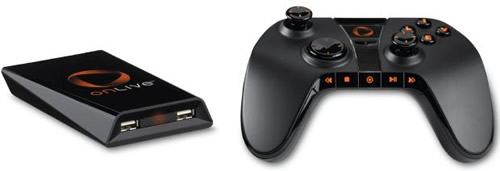
    OnLive will also be selling a router-sized "MicroConsole" which has USB, HDMI, and Ethernet ports. By hooking the MicroConsole up to your TV and broadband line, you can play OnLive games sans computer. The service will require you to pay, but OnLive CEO Steve Perlman believes the console, controller, and subscription fee will be cheaper than the cheapest of consoles.

    Read more...

    Wednesday, September 2, 2009

    Sony announces 11.1" ultraportable VAIO X notebook

    S
    Sony has introduced the new ultra-thin VAIO X laptop series today in Berlin at the IFA 2009 electronics event. There aren't too many details available yet, but based on reports from outfits attending the gathering, it's a premium ultra-portable with a non-glossy 11.1" display, a carbon fiber .55" chassis, and weighs a mere 1.5lbs.


    According to Engadget (who is on site), the system will tout an "all-day" battery life, and will set a new standard for stamina. There is nothing official about what will power the VAIO X at launch, but Engadget is reporting that they hear it packs an Intel Atom. That said, nothing is locked in and there's no telling if CULV-based models will be available.


    After watching a video shot by NetbookNews, I have to admit that while attractive, the model they handled was looking a little fragile (watch the display as it's opened). Sony is expected to announce an official spec sheet next month, and the VAIO X will hit stores about a week after Windows 7's October 22 launch. Does anyone want to take a stab at the MSRP?

    Read more...

    Nokia reveals full specs and price of Booklet 3G

    E
    arly last week, Nokia announced its much-expected entry into the netbook space with the Booklet 3G. The company hyped the device's 3G connectivity, lightweight design and alleged 12 hours of battery life; but for the most part hardware details were kept under wraps. Now, with its Nokia World Conference currently underway in Germany, the Finnish manufacturer has shed some additional light on its netbook.

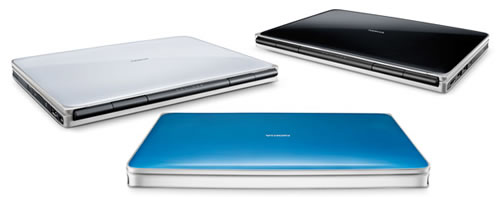
    The Booklet 3G is constructed from a single piece of machined aluminum, weighs 2.75 pounds, and is just 0.78 inches thick. Color options at launch will be black, ice (white) and azure (blue). The device has a 10-inch screen with a 1280x720 pixel resolution, and can connect to bigger displays using an HDMI port, according to Nokia. It also sports an almost unheard of 16-cell user-removable battery to accomplish the promised half-day runtime.


    Under the hood there is an Intel Atom Z530 running at 1.6 GHz and Poulsbo US15W chipset with a fanless design, as well as 1GB of memory and a 120GB hard drive (1.8-inch, 4200RPM). As expected of a Nokia device, there are plenty connectivity options, including Wi-Fi and 3G/HSPA cellular data network access thanks to a modem and hot-swappable SIM card slot. Other specs include a 1.3-megapixel webcam with integrated microphone, 3 USB ports, Bluetooth, assisted GPS, SD card reader and even an accelerometer.

    On the software side, the netbook will come pre-loaded with Microsoft's Windows 7 (Starter, Home Premium or Professional editions) and Nokia services like Ovi Suite 2.0, Nokia Music for PC and Ovi Maps. The Nokia Booklet 3G will retail for 570 Euros (about $810) in Q4 2009, which seems quite pricey for a netbook, but Nokia is expecting the device to be heavily subsidized by phone carriers globally.

    Read more...

    USB 3.0 certification begins, devices closer to debut

    Y
    esterday the new SuperSpeed USB standard, USB 3.0, took another step closer to becoming a reality for consumers as the USB Implementers Forum announced the availability of its compliance and certification program. Interested companies can register for testing on USB-IF's site.

    Those products that pass the tests will carry a SuperSpeed USB logo that promises interoperability with existing USB 2.0 products and the 3.0 improvements, naturally. Announced as far back as 2007, the next-gen interface is expected to provide users with up to 5Gbps transfer speeds, or roughly ten times the speed of USB 2.0. Unfortunately, USB 3.0 devices are not expected to reach its full potential at launch, with speeds probably reaching only 1.2Gbps initially and improving as the standard matures.

    Hardware featuring SuperSpeed USB should arrive towards the end of the year -- we already saw a USB 3.0-packing motherboard from Asus back in July but it reportedly got canceled shortly thereafter. Widespread adoption is still far off, however. According to estimates from research firm IDC, the new standard is expected to grab 30 percent of the USB market share by 2013.

    Read more...

      © Blogger templates ProBlogger Template by Ourblogtemplates.com 2008

    Back to TOP