Wednesday, February 24, 2010

Fun Facts: How Small is 32 Nanometers?

E
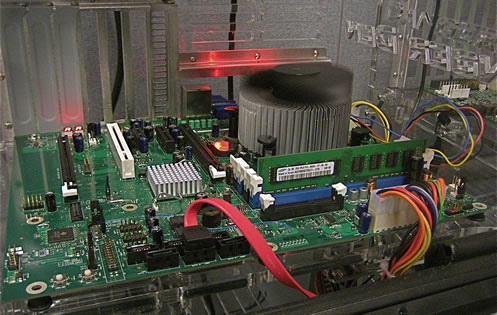
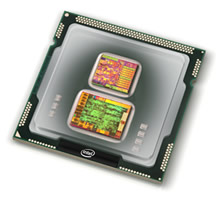
arlier this year Intel made a big splash with a new generation of Core i3 and Core i5 processors using the uber small 32 nanometer manufacturing process. Although this is eventually going to get dumped as ancient technology for an even smaller and more efficient way to produce chips, today it's state of the art.

Intel recently published a whitepaper with some amusing 32nm facts that we are reproducing here for you. If you have ever wondered how small the logic inside these chips really is in 'measurable' terms, here are some random facts to give you some perspective:


  • A nanometer is so small that it takes a billion of them to make a meter. A billion is a huge number. A stack of a billion sheets of paper would be 100 km high. If you could walk a billion steps, you would go around the earth 20 times.


  • The original transistor built by Bell Labs in 1947 was large enough that it was pieced together by hand. By contrast, more than 60 million 32nm transistors could fit onto the head of a pin.


  • More than 4 million 32nm transistors could fit in the period at the end of this sentence.


  • A 32nm transistor contains gates that are so small, you could fit 3,000 of them across the width of a human hair.


  • A 32nm transistor can switch on and off over 300 billion times in one second. It would take you 4000 years to flick a light switch on and off that many times.


  • Compared to Intel’s first microprocessor, the 4004, introduced in 1971, a 32nm CPU runs over 4000 times as fast and each transistor uses about 4000 times less energy. The price per transistor has dropped by a factor of about 100,000.


  • The “World’s Fastest Man,” Usain Bolt would have to take 3,125,000,000 steps in the 100 meter dash if his stride length was 32nm.


  • If the pace of innovation in space travel had increased at the pace of Moore’s Law since 1971, you would now be able to travel at the speed of light, 671 million miles per hour.


  • Intel has shipped over 200 million CPUs using high-k/metal-gate transistors – the kind used in 32nm processors -- since the technology was first put into production in November 2007. This translates to over 50,000,000,000,000,000 (50 quadrillion) transistors, or the equivalent of over 7 million transistors for every man, woman and child on earth.


  • The price per transistor on a chip has dropped dramatically since Intel was founded in 1968. Some people estimate that the price of a transistor is now about the same as that of one printed newspaper character.


  • Read more...

    Microsoft, Amazon ink cross-licensing agreement

    M
    icrosoft and Amazon have inked a new cross-licensing agreement that gives the companies access to some of each other's patents. Details are limited, but Microsoft mentioned that Amazon's Kindle e-reader and the shopping giant's use of Linux-based servers are included. Microsoft didn't specify what intellectual properties it would share with Amazon.

    Along with the licensing arrangement, it's said that Amazon will pay Microsoft a chunk of money, but the companies didn't say how much. In fact, the motive behind the deal itself is undisclosed. Some suggest Amazon agreed to the terms to avoid a patent-infringement suit from Microsoft. Other companies that use Linux have signed patent deals, and Redmond has repeatedly claimed the software violates some of its patents.


    About a year ago, Microsoft sued TomTom over eight patents -- including three related to the GPS-maker's implementation of the Linux kernel. ITIC principal Laura DiDio noted, "It makes more sense for companies to make nice and do a cross-licensing agreement -- Microsoft has come to realize that legal action is often more costly than it is worth."

    Microsoft has entered more than 600 licensing agreements since the company launched its IP licensing program in December 2003.

    Read more...

    Windows 7 RC's bi-hourly shutdowns begin on Monday

    J
    ust a quick heads up for those who signed up to run the Release Candidate (build 7100) version of Windows 7 and never upgraded to the final code: get going with that or prepared to be annoyed. Starting this Monday, March 1st, besides showing an expiration notification on the taskbar, your system will start to shut down every two hours and any unsaved work will be lost in the process.


    Those brave souls who ignore the "reminders" and work their way around the shutdowns will face one more phase in the expiration process. On June 1, if you are still on the Windows 7 RC, your license will expire and the non-genuine experience will be triggered. This means Windows will boot to a black desktop and users will still have to deal with the constant notifications and bi-hourly shutdowns.

    As annoying as all this may sound, especially for those who have been running the test release as their main installation, we can't say Microsoft wasn't clear about the whole expiration process from the get go.

    That said, if you need some more time to back up your stuff there is a little-known (and perfectly legal) way to extend your RC license as many as 90 more days -- just open a command prompt window with administrator privileges, enter "slmgr -rearm" (minus the quotes) and reboot. The 'trick' can be used up to three times and each will give you 30 days to go grab a legal copy of Windows 7 and upgrade.

    Read more...

    Tuesday, February 23, 2010

    High school uses notebook webcams to spy on students

    T
    he parents of a Lower Merion high school student have filed suit against the district for using school-issued laptops to spy on kids. The school rigged notebooks with software that lets officials remotely view and capture images with the built-in camera -- a mechanism that was supposedly greatly misused. The plaintiff's child claims to have been disciplined in school for "improper behavior" at home, and the Vice Principal used a photo taken by the webcam as evidence.

    In a statement yesterday, Superintendant Dr. Christopher McGinley confirmed that the laptops indeed have a "security feature" to track missing systems. The "feature" can take a "still image of the operator and the operator's screen," but McGinley said it has been deactivated, and will not be reactivated without express written notification. He also insisted that the feature has only been used to locate lost, stolen or missing laptops.

    Students involved in the suit have contacted Gizmodo with details about the situation. It's said that the green lights next to the kids' laptops often turns on, suggesting it's in use, but the district claims it's just a glitch. One student questioned a school IT guy about the light, who said it was occurring because "people logged out when an application using the camera was on." The employee also admitted that the school could in fact look through the webcam, but it would violate law.

    Read more...

    Nvidia Ion 2 slower than the original Ion?

    A
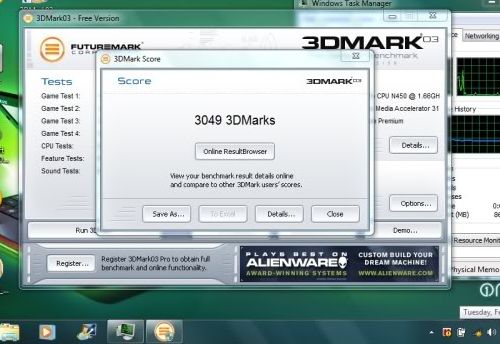
    cer last week announced its Aspire One 532G netbook as the first to carry Nvidia's forthcoming Ion 2, but few details have been revealed about the next-gen graphics chip. Some folks at NetbookNews recently got their hands on the Aspire One 532G at Mobile World Congress, and they managed to sneak in a 3DMark 03 graphics benchmark.

    While the results aren't conclusive, the Ion 2 actually performed worse than the original. The Aspire One 532G scored 3,049 3DMarks, which compares to 3,593 3DMarks for the Ion LE-equipped Samsung N510. Netbook Choice speculates that this may show issues Nvidia has faced with Intel's Pine Trail architecture.


    Since the GPU-maker isn't allowed to create chipsets around DMI, the Ion 2 likely uses PCIe to interface with Pine Trail. It's suggested that limited bandwidth over PCIe could be the culprit -- at least partially -- but there are other explanations. For instance, Acer and Nvida might have crippled the system to keep it stable while being shown at MWC. Unpolished drivers could also be responsible.

    An Nvidia representative quickly responded to the unflattering benchmark results: "I can’t vouch for the accuracy of the benchmark that was performed at that show. I believe the units there were pre-release systems. We haven’t provided performance data yet for the public, we’ll have more details coming in early March."

    Read more...

    Lenovo intros six new Think-branded business computers

    L
    enovo has announced it will ship six new Think-branded business-minded computers
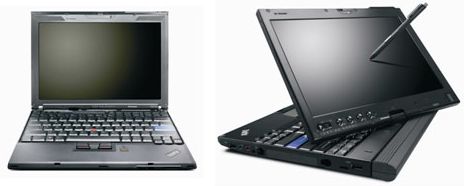
    next month. The company flaunts its ThinkPad X201 as the industry's fastest ultraportable laptop, the X201s as the thinnest and lightest in its product line, the X201t is the "smart tablet for business users," and the W701 and W701ds mobile workstations are the most powerful ThinkPads.


    The ThinkPad X201, X201s, and X201t all have 12.1-inch displays (capacitive multitouch for the tablet), an Intel Core i5 or i7 processor, Intel graphics, up to 8GB of RAM, have a range of disk and solid-state storage options, and run Windows XP or 7. The X201 and X201s offer up to 11 and 12 hours of battery life, and both weigh less than three pounds. In order of mention, prices start at $1,199, $1,599, and $1,549.

    The ThinkPad W701 and W701ds workstations sport 17-inch screens, with the latter also packing a 10.6-inch display. Apart from the dual-screen, the machines are seemingly identical. Both carry either a Core i7-920 or i7-820QM processor, an Nvidia Quadro FX 3800M or FX2800M GPU, up to 16GB of RAM, an HDD or SSD, Windows XP or 7, and weigh around nine pounds. Prices start at $2,199 and $3,799. 


    Lenovo says its ThinkServer TS200v "goes big on features and performance" with prices kicking off under $500. It can be configured with a handful of Core i3 and i5 processors, but scales all the way down to the Pentium G6950 and Celeron G1101. Other features include a DVD drive, room for two 3.5-inch drives in RAID 0/1, gigabit Ethernet, PCI as well as PCIe X1 and x16 slots, ten USB ports, and VGA-out.

    Read more...

    Monday, February 22, 2010

    U.S. authorities close in on Chinese Google hackers

    U
    .S. authorities have reportedly tracked down the hacker who wrote the code behind the attacks on Google and a number of other local companies last month. Serious questions had already been raised about the likelihood of the attacks being in some way sanctioned by the Chinese government, and today's development seems to further back that notion.

    Turns out the alleged hacker is a Chinese "freelance security consultant in his 30s" who had published extracts of his IE6 exploit code as a work in progress. Although this man did not launch any attacks himself, according to The Financial Times, Chinese officials have "special access" to his work and are believed to have picked up the code.


    The spyware's launch was recently traced to computers at Shanghai Jiaotong University and Lanxiang Vocational School, the first of which counts former government cyber security experts among its staff. Both institutions have denied involvement in the attacks, of course. The latest findings don't give a definite answer as to who was behind the attacks, but it might put some extra pressure on China to cooperate with the ongoing investigations.

    Read more...

    Sunday, February 21, 2010

    Weekend Open Forum: What's your preferred mobile phone platform and handset?

    I
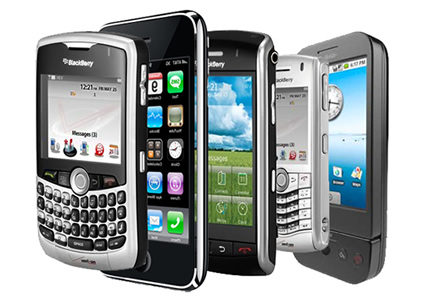
    n the past three years we've seen a number of new smartphone operating systems burst onto the scene. From Apple's wildly successful iPhone OS, to Google's increasingly popular Android and Palm's praised yet still floundering WebOS -- to name a few. Microsoft is no stranger to the market either, but just recently the company took a radical departure from its previous business-centered strategy and unveiled what looks to be a potentially solid contender in the consumer space: the Windows Phone 7 Series.

    All of them are characterized for powering a new generation of touch-driven, fast and feature-rich devices that evermore seem to be turning into pocket-sized computers. The fact that three of the most significant companies in desktop computing -- Apple, Google and Microsoft -- now stand to occupy the same positions in mobile is a clear indication of where the industry is going.


    Others like Nokia and RIM have arguably been a bit slower to adapt to the latest trends -- or have preferred to focus their efforts on a particular niche -- but still command an undeniable large portion of the cell phone market. Like them there are also a number of big-name industry players peddling their own platforms and hardware, including Samsung, Sony Ericsson, Motorola, Toshiba, HTC and LG Electronics.

    In this edition of our Weekend Open Forum we want to know what kind of device you are currently using. Have you jumped into the smartphone and mobile app craze? Are you more of the business user type? Or perhaps you are comfortable with anything that can make a simple phone call? Feel free to share what you love or hate about your current hardware and mobile platform, as well as any plans for your next purchase.

    Read more...

    Ubisoft's new DRM more annoying than expected

    Y
    ou may recall Ubisoft's recent decision to axe StarForce DRM in favor of a new online platform. The company's online services platform sounded similar to Steam, letting users play from multiple machines without discs -- but it wasn't perfect. The platform required a permanent Internet connection. Needless to say, gamers weren't happy.

    Despite disapproval, Ubisoft is pressing on with the technology. CVG has received Assassin's Creed II and Settlers VII for review, and both are laced with the new mechanism. Granted, being forced to have your machine online is annoying, but the flaws run a bit deeper.

    CVG says that if you're disconnected while playing, you're kicked from the game and all progress from the last checkpoint or save is lost. Naturally, this occurs whether your cat unplugs your router, your ISP has issues, or if Ubisoft's servers crash.


    Piracy may not be the driving force behind Ubisoft's new platform, but the company has said any initiative that decreases illegal downloads will allow it to pour more cash into the creation and expansion of intellectual properties.

    What about the resources wasted in an attempt to prevent the inevitable? We all know that Assassin's Creed II and other popular titles will hit torrent sites around the same time as retail shelves. Resistance is futile.

    Shouldn't companies focus more on rewarding paying customers rather than punishing them for the deeds of a few bad apples?

    Read more...

    Friday, October 16, 2009

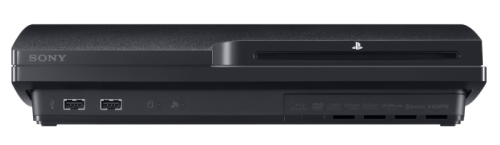
    Gaming Sony announces 250GB PlayStation 3, due November 3

    F
    ollowing the successful launch of a slimmer PlayStation 3 model back in September, Sony has announced a beefier 250GB variant of the console is due to hit U.S. stores next month priced at $350. Besides upping storage capacity
    , the new system will be otherwise identical to the existing 120GB version which sells for $50 less.


    The move comes as expected after leaks suggesting a larger-capacity PS3 would arrive sometime in October. Contrary to some rumors, however, for now the 250GB console has not been announced as part of any bundle like we've seen elsewhere -- Japan will be getting a Final Fantasy XIII bundle in December, for example, while customers in Europe can now get the new 250GB model packed alongside Naughty Dog's Uncharted 2. Hopefully Sony will announce a similar deal for U.S. customers in time for the holiday season.

    Those who recently bought the 120GB version, and PS3 owners in general, might be interested to know that you can also swap out the 2.5-inch SATA drive yourself without voiding the warranty on your PlayStation 3. A quick search online shows that a 320GB hard disk drive can be had for around $56 and a 400GB model for $70, so you'll have to pay a little a premium assuming you even need more storage capacity.

    Read more...

    Monday, October 5, 2009

    Fake antivirus software posing large security threat to users


    W
    ith the Internet evolving, the security risks users face on a day-to-day basis have become increasingly complicated. Security vendors are the most aware of this, challenged with protecting people's PCs from ever-expanding threats without turning a computer into an inert hunk of plastic. Their most difficult challenge yet may be one that has began to emerge relatively recently, in the form of fake anti-virus suites that try to convince people they are real -- usually to bleed money from them.

    Just how big of a problem are fake anti-virus programs, though? Comparing 2008 to 2009, there has been a reported five-fold increase in the number of fake A/V detections. The primary reason for this right now is cited as a constant-changing checksum on a tainted piece of software, leading to hundreds of thousands of variants -- making it more difficult to detect amongst a wide array of machines. One particular security group, APWG, believes that as this evolution of fake software continues, the demand placed on real anti-virus scanners may become overwhelming.

    One of the real problems, they noted, is that most software today relies on signature-based detections. Software which changes itself on a per-download basis is easily able sneak past this. It's further complicated because many of these fake programs often try to use a bit of social engineering to accomplish their goals -- convincing people they are real, which would get past virtually any software protection. APWG also indicated that the number of machines being infected year by year is actually going up, as opposed to going down. Are malicious software writers getting that much better, or are security vendors slipping? It has always been an interesting battle to watch -- unfortunately, end users are caught in the middle.

    Read more...
    AVG touts faster scans and new features with AVG 9.0


    H
    ot on the heels of Microsoft's Security Essentials launch last week, AVG Technologies is unveiling a major update to its free and paid internet security products which the company claims brings much faster scan times as well as a number of under-the-hood improvements.

    Responding to customer feedback the security firm has reportedly put special focus on improving the user experience and ease of use. As a result, version 9.0 is said to be "up to 50 percent" faster than its predecessor, thanks to more sophisticated caching techniques and memory use. Boot times have also been reduced by around 10 to 15 percent and overall the installation process on the full-fledged suite has been shortened from 22 screens to 11.

    In addition to the anti-phishing protection offered through LinkScanner, AVG 9.0 now also includes additional protection against identity theft in the physical world (for US customers only) with the AVG Identity Theft Recovery Unit (ITRU). Meanwhile, firewall enhancements include a complete redesign and a new cloud-based white listing database to reduce the amount of user input required to secure a PC.

    Both AVG Internet Security 9 and AVG Anti-Virus are available now for a one-year license of $49.99 and $34.99, respectively. The main difference between the two is that AVG Anti-Virus lacks the firewall, identity protection, anti-spam, and system tools that come in AVG Internet Security. As always, a cut-down free version will also be available but starting from mid-October.

    Read more...

    Wednesday, September 9, 2009

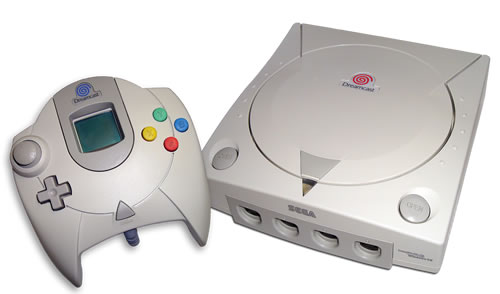
    Pioneer console Sega Dreamcast turns 10

    C
    onsoles have come a long way in a short time, evolving alongside computers as one of the center pieces for video game entertainment. As the line between computer and console begins to blur, it's easy to forget just how far the console has journeyed. A good reminder of that came this week, when the Sega Dreamcast turned ten years old.

    The much-hyped console was highly anticipated by gaming communities all over the world, but it ended up proving to be a disaster for Sega as a company, as it was their last console endeavor. Even though it was a commercial failure, the console pioneered many of the ideas that are common among modern consoles.


    The idea of an Internet-connected gaming console was first realized with the Dreamcast, which came stock with a built-in dial-up modem and featured one of the first console web browsers. Along with the PC, it was one of a very few hardware devices that allowed people to play games with each other online. The Dreamcast also had a controller design that is suspiciously similar to the Xbox 360's -- though that may be just a coincidence.

    Though other consoles quickly surpassed the Dreamcast, including the current most popular console in the world (PlayStation 2), it was an example of high technology at the time and is curious to look back on.

    Read more...

    Russia drops Microsoft antitrust probe over Windows XP

    R
    ussia's competition regulator, the Federal Antimonopoly Service (FAS), has dropped a probe launched against Microsoft back in June over alleged violations to the country's laws. The agency had accused Redmond of having unfair pricing policies and restricting Windows XP sales to retailers and OEMs, even though there was continued demand for the older operating system, forcing customers to use Vista instead.

    As noted in our previous coverage, Microsoft is obviously keen to move customers on to its newest operating systems not just to increase sales but also to reduce support costs. Despite this the company reportedly supplied evidence to the FAS that XP was in fact still available and that it had sold over a million Russian language copies of the operating system in fiscal 2008 (which ended on June 30, 2008).

    As part of the agreement to drop the case, Microsoft said it will give Russian users the option of exchanging their copies of Vista Home Basic or Home Premium for Windows XP Home, free of charge. The exchange program will kick off in the next three weeks and will last until the end of 2009.

    Read more...

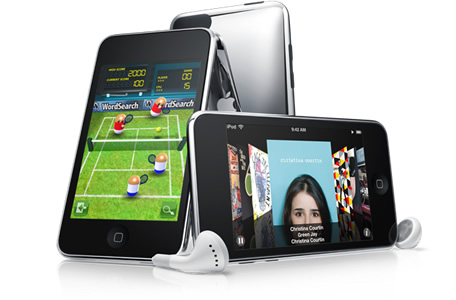
    Apple updates iPod lineup, nano gets video camera

    A
    s expected, Apple unveiled new iPod models across the board today which bring added functionality and lower prices. A recovered Steve Jobs took the stage for the first time in almost a year to announce that over 225 million iPods have been sold since its introduction in 2001, with the iPod touch representing 20 million of that number and contributing to an overwhelming 74% market share.


    Starting at the high end, Apple touted an update to the iPod touch line that will see it packing the same processing platform as the recently introduced iPhone 3GS -- meaning they now support improved graphics with Open GL ES 2.0. This is true for both the 32 and new 64GB models, priced at $299 and $399 respectively, while the last-gen 8GB iPod touch will remain available for just $199. There doesn't appear to be a built-in camera, however, contrary to all the rumors.

    Moving on the iPod classic was updated with a 160GB HDD but kept its $249 price tag. On the other end of the spectrum, the shuffles are now at $59 for 2GB, $79 for 4GB and come in black, silver, pink, green and blue. There's also a polished aluminum 4GB version for $99.


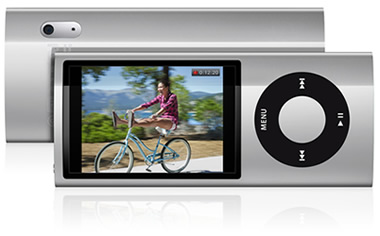
    Last but not least, Apple's iPod nano got a revamp and is now available in capacities up to 16GB. Its design remains mostly unchanged from the previous model, if not for the larger 2.2-inch display, but gains a built-in camera and mic for recording 640 by 480 pixels, 30 FPS video -- apparently it does not take still photos. After years of dismissing the feature, Apple has also added an FM radio tuner to the nano, as well as pedometer and voice over functionality. The 8GB iPod nano is priced at $149 while the 16GB model goes for $179.

    Read more...

    Tuesday, September 8, 2009

    Intel Core i5 750 Processor Review

    I
    t has been 10 months since Intel unleashed its Nehalem architecture and we showed you the Core i7 920, 940 and 965 Extreme Edition. Not much has changed in the high-end sector during this timeframe, as Core i7 processors are still brutally fast and equally expensive.

    The new Intel Core i5 750 is the first release in a series of processors based on a mainstream version of the Core i7 platform. It is a quad-core part based on the "Lynnfield" architecture, fabricated using a 45nm process and utilizing the new LGA1156 platform. The Core i5 750 is set to cost just $199, it will operate at a healthy 2.66GHz and feature a whopping 8MB L3 cache, but no Hyper-Threading support will be present.


    In our review we will go into more detail about Intel's reworked desktop CPU line-up, the new P55 chipset (LGA1156), and our usual load of benchmarks comparing this new processor against current Core 2 Quad offerings, the Core i7 920 and the AMD Athlon II X4 965.

    Read more...

    Zero-day Windows Vista, 7 vulnerability discovered

    M
    icrosoft is looking into a zero-day vulnerability today, which reportedly affects systems running Windows Vista and 7. Researcher Laurent Gaffie said that a hacker could exploit the flaw on Windows 7 to cause a critical system error. The flaw lies in a Server Message Block 2 (SMB2) driver.

    Gaffie said in a blog post yesterday, "SRV2.SYS fails to handle malformed SMB headers for the NEGOTIATE PROTOCOL REQUEST functionality." People who have commented on his blog post are reporting that the exploit can not only lead to denial of service, but also remote code execution.


    Gaffie has contacted Microsoft, and it has since responded by saying that it is investigating the issue but that it is "unaware of any attacks trying to use the claimed vulnerability or of customer impact." The H has successfully tested the proof-of-concept code, which caused a reboot on Vista -- but did not work on Windows 7.

    Read more...

    Firefox 3.6 to arrive this year, 4.0 in late 2010

    A
    lthough Mozilla released Firefox version 3.5 not long ago, the team has been showing mockups of future designs. In addition to embracing glass on Windows Vista and 7, future versions will have reorganized interfaces. Previews of Firefox 4.0 suggest that it may have a combined and relocated reload, stop and go buttons, as well as a tab sidebar, tabs on top, and many other UI tweaks -- none of which are set in stone.


    Mozilla is now indicating that we may see the launch of Firefox 4.0 next October or November. It has also reportedly updated its roadmap for the release of Firefox 3.6 and 3.7, with the former expected to debut later this year and the latter to arrive in the second quarter of next year. There are also reports that Fennec 1.0 -- the mobile version of Firefox -- will be made available at the same time as Firefox 3.6, and Fennec 2.0 with Firefox 4.0.

    If the suspense is killing you, fear not; pre-release builds are available. Feel free to download Firefox 3.6 and 3.7 at your own risk.

    Read more...

    Worm attacks WordPress blog software

    S
    erving as a stern reminder of why it's important to keep desktop as well as server software up to date, a new worm can reportedly infect certain versions of the WordPress blog software. WordPress announced the discovery today, saying that a security bug which has already been fixed is now being exploited in the wild.

    The worm is able to attack versions of WordPress prior to 2.8.4 and its immediate predecessor. Version 2.8.4 was released in early August to specifically address this flaw, which results in a password reset of WordPress accounts and allows someone to take control of the admin account. Doing so would give the person access to further information, as well as the ability to wreak havoc on the blog itself.

    Though the vulnerability was initially published several weeks ago, this is the first report of malware specifically identifying and trying to exploit it. The WordPress developer is concerned that many servers are still running old versions, which puts them at risk. If you're maintaining a WordPress server that's behind on updates, consider this a heads up.

    Read more...

    Monday, September 7, 2009

    Samsung hopes to launch OLED laptops next year

    S
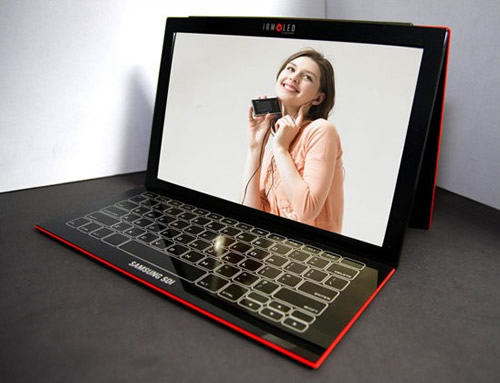
    amsung is hoping to launch OLED-equipped laptops by the third quarter of next year. According the company's head of worldwide sales and marketing, Kyu Uhm, Samsung is the largest OLED screen manufacturer. Uhm added that Samsung will adopt OLED displays as soon as they are commercially available for laptops.

    Research firm Gartner believes that mainstream OLED notebooks will have an increasing presence over the next five years. Samsung is surely sold on the technology, having already shown off an AMOLED notebook prototype. Introducing an OLED laptop toward the end of 2010 woul


    In October of 2007, the company said it planned to have 3.5" to 7" panels prepared for ultra-portable systems in 2008, which would be followed by 14", 15", and 21" displays for laptop and desktop computers in 2009. It predicted that it would have full 40" and 42" HD OLED panels by 2010 and Flexible OLED (FOLED) displays by 2012 at the latest.

    Read more...

      © Blogger templates ProBlogger Template by Ourblogtemplates.com 2008

    Back to TOP