Showing posts with label microsoft. Show all posts

Wednesday, February 24, 2010

Microsoft, Amazon ink cross-licensing agreement

M
icrosoft and Amazon have inked a new cross-licensing agreement that gives the companies access to some of each other's patents. Details are limited, but Microsoft mentioned that Amazon's Kindle e-reader and the shopping giant's use of Linux-based servers are included. Microsoft didn't specify what intellectual properties it would share with Amazon.

Along with the licensing arrangement, it's said that Amazon will pay Microsoft a chunk of money, but the companies didn't say how much. In fact, the motive behind the deal itself is undisclosed. Some suggest Amazon agreed to the terms to avoid a patent-infringement suit from Microsoft. Other companies that use Linux have signed patent deals, and Redmond has repeatedly claimed the software violates some of its patents.


About a year ago, Microsoft sued TomTom over eight patents -- including three related to the GPS-maker's implementation of the Linux kernel. ITIC principal Laura DiDio noted, "It makes more sense for companies to make nice and do a cross-licensing agreement -- Microsoft has come to realize that legal action is often more costly than it is worth."

Microsoft has entered more than 600 licensing agreements since the company launched its IP licensing program in December 2003.

Read more...

Windows 7 RC's bi-hourly shutdowns begin on Monday

J
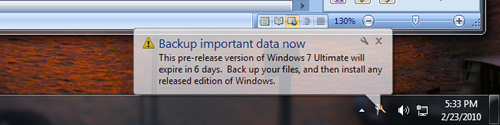
ust a quick heads up for those who signed up to run the Release Candidate (build 7100) version of Windows 7 and never upgraded to the final code: get going with that or prepared to be annoyed. Starting this Monday, March 1st, besides showing an expiration notification on the taskbar, your system will start to shut down every two hours and any unsaved work will be lost in the process.


Those brave souls who ignore the "reminders" and work their way around the shutdowns will face one more phase in the expiration process. On June 1, if you are still on the Windows 7 RC, your license will expire and the non-genuine experience will be triggered. This means Windows will boot to a black desktop and users will still have to deal with the constant notifications and bi-hourly shutdowns.

As annoying as all this may sound, especially for those who have been running the test release as their main installation, we can't say Microsoft wasn't clear about the whole expiration process from the get go.

That said, if you need some more time to back up your stuff there is a little-known (and perfectly legal) way to extend your RC license as many as 90 more days -- just open a command prompt window with administrator privileges, enter "slmgr -rearm" (minus the quotes) and reboot. The 'trick' can be used up to three times and each will give you 30 days to go grab a legal copy of Windows 7 and upgrade.

Read more...

Sunday, February 21, 2010

Weekend Open Forum: What's your preferred mobile phone platform and handset?

I
n the past three years we've seen a number of new smartphone operating systems burst onto the scene. From Apple's wildly successful iPhone OS, to Google's increasingly popular Android and Palm's praised yet still floundering WebOS -- to name a few. Microsoft is no stranger to the market either, but just recently the company took a radical departure from its previous business-centered strategy and unveiled what looks to be a potentially solid contender in the consumer space: the Windows Phone 7 Series.

All of them are characterized for powering a new generation of touch-driven, fast and feature-rich devices that evermore seem to be turning into pocket-sized computers. The fact that three of the most significant companies in desktop computing -- Apple, Google and Microsoft -- now stand to occupy the same positions in mobile is a clear indication of where the industry is going.


Others like Nokia and RIM have arguably been a bit slower to adapt to the latest trends -- or have preferred to focus their efforts on a particular niche -- but still command an undeniable large portion of the cell phone market. Like them there are also a number of big-name industry players peddling their own platforms and hardware, including Samsung, Sony Ericsson, Motorola, Toshiba, HTC and LG Electronics.

In this edition of our Weekend Open Forum we want to know what kind of device you are currently using. Have you jumped into the smartphone and mobile app craze? Are you more of the business user type? Or perhaps you are comfortable with anything that can make a simple phone call? Feel free to share what you love or hate about your current hardware and mobile platform, as well as any plans for your next purchase.

Read more...

Wednesday, September 9, 2009

Russia drops Microsoft antitrust probe over Windows XP

R
ussia's competition regulator, the Federal Antimonopoly Service (FAS), has dropped a probe launched against Microsoft back in June over alleged violations to the country's laws. The agency had accused Redmond of having unfair pricing policies and restricting Windows XP sales to retailers and OEMs, even though there was continued demand for the older operating system, forcing customers to use Vista instead.

As noted in our previous coverage, Microsoft is obviously keen to move customers on to its newest operating systems not just to increase sales but also to reduce support costs. Despite this the company reportedly supplied evidence to the FAS that XP was in fact still available and that it had sold over a million Russian language copies of the operating system in fiscal 2008 (which ended on June 30, 2008).

As part of the agreement to drop the case, Microsoft said it will give Russian users the option of exchanging their copies of Vista Home Basic or Home Premium for Windows XP Home, free of charge. The exchange program will kick off in the next three weeks and will last until the end of 2009.

Read more...

Tuesday, September 8, 2009

Zero-day Windows Vista, 7 vulnerability discovered

M
icrosoft is looking into a zero-day vulnerability today, which reportedly affects systems running Windows Vista and 7. Researcher Laurent Gaffie said that a hacker could exploit the flaw on Windows 7 to cause a critical system error. The flaw lies in a Server Message Block 2 (SMB2) driver.

Gaffie said in a blog post yesterday, "SRV2.SYS fails to handle malformed SMB headers for the NEGOTIATE PROTOCOL REQUEST functionality." People who have commented on his blog post are reporting that the exploit can not only lead to denial of service, but also remote code execution.


Gaffie has contacted Microsoft, and it has since responded by saying that it is investigating the issue but that it is "unaware of any attacks trying to use the claimed vulnerability or of customer impact." The H has successfully tested the proof-of-concept code, which caused a reboot on Vista -- but did not work on Windows 7.

Read more...

Tuesday, September 1, 2009

Windows Mobile 6.5 phones to arrive on October 6

P
hones running Microsoft's new Windows Mobile 6.5 operating system will hit the market in exactly five weeks, according to a recent press release. The October 6 launch will mark the debut of the new "Windows Phone" brand, along with the new My Phone synchronization service and the Windows Marketplace for Mobile, Microsoft's attempt to rival Apple's App Store for the iPhone.

The company has not specified which handsets will be available on launch date, but said HP, HTC, LG Electronics, Samsung, and Toshiba are all committed to the OS. The first phone offerings in the U.S. will be on carriers AT&T, Sprint and Verizon, as well as Bell Mobility and TELUS. Devices will also debut on Orange, Deutsche Telekom AG and Vodafone in Europe; and several other carriers in Asia Pacific and Latin America.

With everyone trying to duplicate the iPhone's experience these days, it's easy to forget Windows Mobile is still the third-most used system behind Symbian and RIM's BlackBerry platform. That said, they are facing increased pressure from Apple's iPhone, Google's Android, and Palm's webOS; and it seems to me that this relatively minor update which touts document editing with Windows Office Mobile and a "redesigned Internet Explorer Mobile browser" among its selling points won't do much to stop the market share bleeding.

The new version also improves the user interface to make it finger-friendly, includes improved notifications and updates from e-mail, text and calendar, as well as an App Store-like hub for software downloads -- although Microsoft hasn't confirmed how many apps will be available for download at launch.

Read more...

Monday, August 31, 2009

Microsoft Office Build 4417 leaked

 A
s usual, when Microsoft has a new operating system or productivity suite on the assembly line, the public domain has a front seat show. Microsoft Office 2010 Build 4417 has reportedly hit the Web with some minor tweaks and improved stability.

According to Neowin, the most noteworthy change to Build 4417 is that Redmond has fine-tuned and polished the Back-Stage view feature. The latest leak packs a new upload center to store and share documents online, a new activation system, and updated icons. Users are reporting that the uninstall issues of a previously leaked Mondo build have been corrected, and the current version can be uninstalled.


Microsoft Office 2010 first leaked to torrent sites back in May, and Microsoft pushed out a technical preview on July 13. I have no doubt there will be many more unofficial builds to come. If you're going to partake in that scene, be careful of shady sources -- it's not uncommon for these leaks to be laced with malware.

Read more...

Friday, August 28, 2009

Microsoft: Xbox 360 failures "well behind us"

M
icrosoft has responded to the recent survey being passed around the Web. Consisting of 5,000 Consumerist readers, the controversial poll suggested that around 54% of the participants experienced at least one Xbox 360 failure - 41.2% said they had at least two go kaput.


According to Xbox Live and Xbox 360 director of product management Aaron Greenberg, while issues inundated the early 360 production lines, things have since improved. "I can tell you the consoles we're making today have lower-heat chips and better cooling, and we're seeing fantastic quality in those consoles today," Greenberg said.

He said that the early problems were acknowledged, and Microsoft responded by introducing an extended three-year warranty for anyone who is faced with the infamous Red Ring of Death or E74 error. Greenberg continued by adding that with the strides taken by Microsoft, he feels like most of the problems are well behind them.

What have your experiences been with the newer Xbox 360 models?

Read more...

Wednesday, August 26, 2009

Microsoft increases Office anti-piracy measures

Y
ear after year, Office turns out to be Microsoft's biggest software cash producer. Beyond Windows and any other single suite, Office is what makes Microsoft scads of dough. Given the relative high cost of the suite, it's no surprise that Office is also one of the most pirated pieces of software in the world. Hoping to curb losses incurred from rampant piracy, Microsoft is introducing some new countermeasures to the newest versions of Office.

The new anti-piracy measures aren't aimed at single users, however. Microsoft isn't losing sleep over the people torrenting Office or pilfering a burned copy from a friend - instead, it is the counterfeiting involved. The software giant is concerned about knockoff copies in cloned packaging. As pirates get more professional, black market copies of Office look more like the real thing - preventing people from determining whether or not a piece of software is genuine.

To accomplish this, Microsoft is expanding "Office Genuine Advantage," a branch of the same anti-piracy arm that most Windows users are familiar with. Primarily, they are increasing how far OGA is available worldwide, and will pass it off as a Windows Update. While at first that may seem like a small act, it's actually a pretty large one - since counterfeiting is a worldwide issue, and Microsoft has largely focused on only certain regions of the world.

Whether or not nagging users with duped software is effective, Microsoft doesn't say. However, their anti-piracy efforts have increased exponentially with time. How much farther will Microsoft (or any software vendor, for that matter) go to prevent their code from being stolen?

Read more...

Tuesday, August 25, 2009

Microsoft extends Windows 7 Family Pack to Europe


E
arlier this year, looking to placate anti-trust concerns in Europe, Microsoft proposed a browser-less version of Windows 7 for the region and then scratched that plan to favor the so-called browser ballot screen option. Its initial plan prevented European users from doing an in-place upgrade from Vista, though, so those who bought a copy of the operating system early were set to receive full licenses at upgrade prices.


Microsoft of course plans to honor those purchases but has now confirmed that, starting September 1, upgrade editions of Windows 7 with Internet Explorer 8 included will be available in the region as well. This leaves a one-week window in which European customers may continue to pre-order full versions of the OS at the upgrade price of €119.99.

Additionally, in a blog posting today at the Windows 7 Team Blog, Microsoft’s Brandon LeBlanc revealed that since upgrade editions will now be offered in Europe, the software giant will also be selling the three-license Family Pack - which contains upgrade editions - in select European countries. These include the UK, Ireland, Germany, France, Switzerland, Austria, the Netherlands and Sweden.

LeBlanc mentioned that versions without Windows Media Player, marked with a prominent “N” and a big red box, will also be available for all Windows 7 SKUs in both full and upgrade editions, but for no discount off the regular price. This version is the result of a previous European antitrust suit over the inclusion of that software in Windows.

Read more...

Monday, August 24, 2009

Microsoft releases new Movie Maker, shows HD webcam

M
icrosoft has released their latest version of Windows Live Movie Maker. The new release has a simplified, more focused feature-set and excludes infrequently used tools. Users can upload videos directly to YouTube and Facebook, burn files straight to DVD, play videos on HDTVs, and save in a wide spectrum of resolutions, including 480i, 720i, 720p and 1080p.

Microsoft has polished the new Movie Maker's storyboard, allowing faster and easier edits than previous versions, and it now supports audio editing. Despite its improved offering, CNET has given the new Windows Live Movie Maker a "so-so" rating. They concluded that although it's decent for its price (free), it doesn't top Apple's iMovie, if you have the cash.


Additionally, Microsoft unveiled a new high-definition webcam named LifeCam Cinema. The LifeCam makes use of ClearFrame Technology and an updated de-noiser, and can record 720p 16:9 video at up to 30 frames per second. It will start shipping next month for about $80.

Read more...

Lenovo, Samsung put Ion-based netbooks on hold until Windows 7 launch

It’s been months since Lenovo first announced what was supposed to be the first Nvidia Ion powered netbook. Although a version of the IdeaPad S12 with Intel-based graphics was indeed released shortly thereafter to favorable reviews, its 1080p capable sibling still shines by its absence. Now the system is being pushed back until the end of October to coincide with the debut of Windows 7.


A specific reason for the delay was not revealed, but Lenovo did say that the experience of Windows 7 on the Ion-based S12 would make it more compelling than the Vista version it was originally planning to sell. Meanwhile, Samsung will reportedly follow suit and delay the release of their Nvidia Ion N510 netbook until they can ship it with Windows 7. While most Vista notebooks sold between now and October 22 are eligible for a free upgrade, apparently their thinking is that not everyone is comfortable with the process.

Samsung is rumored to have several versions of its upcoming Ion powered laptops in the works, so it’s also worth noting the possibility of them releasing an XP version with DirectX 9 support in September (using the cheaper LE variant of Ion), and a version with full DX10 support after Windows 7 is released in October.

Read more...

Wednesday, August 19, 2009

Windows 7 RC downloads end Thursday

Following the planned death of Windows 7 Beta, the RC version that has been freely available to anyone to test since May will no longer be downloadable from Microsoft’s servers after Thursday of this week. This means that if you still haven't jumped on the test wagon, you'll have to wait another two months for the final release to get your hands on a copy.


Those of you already running the near-finished version of Windows 7 can continue using it for free. Even if you miss the August 20 deadline Microsoft says they'll keep handing out license keys for a while, so you can always grab a copy from torrent sites – be sure to verify your ISO, though. You'll have until March 2010 before Microsoft starts forcefully shutting your computer down every two hours and then face expiration on June. That'll give you plenty of time to test Microsoft’s upcoming operating system past the official and final release.

One word of caution: As mentioned by Microsoft themselves and in numerous other sources, there's no upgrade path other than a clean install to move from the RC build to the final version, so that may be one reason to hold off and wait for the official release at this point in time. Should you decide to give it a try anyway, we have posted a guide to dual boot Windows 7 RC with XP/Vista in three easy steps, and another one to reverse the process.

Read more...

Microsoft fights Word sales injunction


M
icrosoft has filed an “emergency motion” to stay a judge’s ruling that threatens to prevent the company from selling its widely used word processing application. The issue boils down to a custom XML function in Microsoft Word 2003 and 2007 that allegedly infringes on a patent held by Canadian firm i4i. Although Redmond claims it is expending enormous human and financial capital to come up with modified versions, failing to do so within the court’s 60-day deadline could potentially keep Word and even Office off the shelves for months.


In its motion, Microsoft asked an appeals court to halt that injunction and also to speedily hear the company's appeal once it is filed. The software giant argues that the patents in question are invalid and furthermore claims the injunction could cause "irreparable harm" to the software giant's business and to its partners.

The stakes are high and alternative productivity suites such as OpenOffice.org or even Google Docs certainly would love to capitalize on this. There are a few possible outcomes, though, and somehow I doubt Office ceasing to be available is one of them. Microsoft could still buy some time with the appeal to work on non-infringing versions of Word or perhaps reach an out-of-court settlement with i4i.

Read more...

Windows 7 Product Editions Compared

B
efore Windows Vista, Microsoft made the sale of its Windows operating system view easy and concise. Windows XP only had Home and Professional editions and the decision was easy because home users used home edition and business users used professional edition. Windows Vista was introduced with six different product editions and made things a little complicated for end users. Some users were unable to differentiate between Vista Home Basic and Home Premium, but the main difference was simply a matter of performance and "eye-candy" between the two versions.


Windows 7 continues the same six product editions but with slightly different names and the ways that they are differentiated. In this article, we will try to break it all down and make it easy to understand because it really isn't that complicated with a little explanation. The chart below is a quick summarization of the various product editions with details and a comparison to a Vista product edition.

Windows 7 Edition Comparable Vista Edition Full / Upgrade Price 32-bit / 64-bit
Starter Home Basic No retail avail. Yes / No
Home Basic Starter No retail avail. Yes / No
Home Premium Home Premium $200 / $120 Yes / Yes
Professional Business $300 / $200 Yes / Yes
Ultimate Ultimate $320 / $220 Yes / Yes
Enterprise Enterprise No retail avail. Yes / Yes

Windows 7 Starter:


Windows 7 Starter:

The lowest-end product edition of Windows 7 is the Starter edition, which will be preinstalled on low-end computers and computers without enough processing power for other editions, such as a netbook. Unlike Windows 7 Home Basic edition, Starter edition will be sold in the United States and other mainstream markets. The system requirements of Windows 7 Starter are the following: a low-end CPU processor, 1GB of RAM, 256GB (max) hard drive, and a 10.2" (or smaller) display.

The interface of Windows 7 Starter is cut down and only includes the Windows Basic interface and not the Windows Aero interface, which is the "glassy" transparent windows. You also do not get Aero Peek and Shake. Windows Media Center is not included, but Windows Media Player is. Users cannot change the desktop wallpaper in this edition, which is a bizarre restriction.

Windows 7 Home Basic:

This Home Basic edition, unlike Starter, will not be sold in mainstream markets, including the United States. It will be installed with low-end PCs in emerging countries, such as India. The system requirements are similar to the Starter edition's requirements above.

Windows 7 Home Premium:

Home Premium will be the edition that an overwhelming majority of computer users in the United States will choose, mostly because it will come pre-installed on new computers after the October 22nd release of Windows 7. This edition comes with all of the desktop enhancements that Windows 7 has to offer, including Windows Aero, Flip 3D, Live Thumbnails, and the ability to customize all aspects of the user interface.

Windows 7 Home Premium comes with all of the multimedia features, such as Windows Media Center, DVD Maker, Windows Media Player, and all of the games that Windows 7 has to offer. Windows Mobility Center is also included, which provides advanced features for laptop and portable devices as well as touch input and multi-touch functionality.

If you are an average to above-average computer user who will use this product in a home or home business setting, this is most likely the edition that you will want. It is priced right at $120 for an upgrade version for current users of Windows XP or Vista and it will definitely run on any computer that decently runs XP and Vista right now.

Windows 7 Professional:

Users of Windows 7 Professional will be small to mid-size businesses and companies who need advanced networking features, such as Active Directory and domain log-in support. Professional also offers network backup, an Encrypting File System (EFS), and the ability to connect to and control a remote PC via Remote Desktop. XP Mode is also available to Professional edition users, which allows users to install and run applications that only work in Windows XP in a seamless Windows 7 environment. Professional edition also supports a larger amount of RAM: 192GB (64-bit) and 16GB (32-bit)

The biggest two questions of whether or not you need Windows 7 Professional are the following: Do you need domain support and do you need seamless backward compatibility for legacy Windows XP applications?

Windows 7 Ultimate:

This edition is for the power-user and computer enthusiast. It includes every single available Windows 7 feature, but is still relatively similar to the Professional edition. Windows 7 Ultimate gives users access to BitLocker and BitLocker To Go, which is a drive encryption system for the system hard drive and portable media, like a USB thumbdrive. Home users will not need any of these more advanced features and the price of $100 extra is most likely not worth spending for it.

32-Bit vs. 64-Bit:

Most of the Windows 7 product editions ship in both 32-bit and 64-bit flavors in the retail package. Users purchasing new PCs will be given a choice of either 32 or 64 bit operating systems at their time of purchase. There are no cosmetic or functionality differences between 32 and 64 bit, but there is one small under-the-hood different. The 64-bit versions of Windows 7 support either 16GB or 192GB of RAM, while the 32-bit editions only support a maximum of 4GB. All new and relatively new CPU's are 64-bit compatible and users should almost always choose 64-bit versions of Windows 7.

Read more...

Wednesday, August 12, 2009

Microsoft: Dropping IE6 support not an option

Despite enthusiastic efforts around the world to move on to something better, IE6 is unlikely to go anywhere for a long time. Numerous alternatives exist, from Microsoft themselves, Mozilla and others, but while the software giant would like to see IE6 gone as much as anyone else it's still up to users to make the final decision to upgrade.


A post on the IEBlog touched on this topic recently and basically concludes that dropping IE6 support is simply not an option, for a variety of reasons. One of these includes the substantial user base that clings to the old browser, which still represents millions of web-connected users. Another and arguably more important reason is the commitment level Microsoft has to maintain.


They are stuck with the fact Windows XP shipped stock with IE6, and they have an obligation to continue supporting it for the lifetime of the product. That's a problem for Microsoft since extended support for Windows XP – and thereby IE6 – continues for another five years.

We're talking just Microsoft here, of course. Any other company around the world can choose to support whomever they wish – YouTube will soon drop support for IE6, most web developers cater exclusively to IE7 or higher and many other sites are urging users to upgrade as well. Ultimately, IE6 will die, but it is clear that Redmond expects that death to be slow and painful.

Read more...

Microsoft permanently barred from selling Word

M
icrosoft has been ordered by a US District Court to halt sales of its popular word processing application, Word. Judge Leonard Davis has ruled that the software-giant is guilty of patent infringement and has prohibited it from selling, importing, testing, demonstrating or marketing any Microsoft Word products able to open XML, DOCX, or DOCM files (XML) files containing custom XML.


Plaintiff i4i sued Microsoft in March 2007 claiming that it violated a 1998 software patent (number 5,787,449) for a document system that eliminated the need for manually embedded formatting codes. One of the fundamental features of the markup language XML is that it is readable by both people and machines. XML allows developers and users to define their own tags for data - unlike other markup languages like HTML which have predefined tags.


Microsoft has already paid $200 million after a federal jury ruled that the XML properties of Word 2003 and Word 2007 infringed on i4i's patent. Redmond accumulated another $77 million in fees after the most recent ruling, $40 million for willful patent infringement and $37 million in prejudgment interest. The company must comply within 60 days and is planning to appeal the verdict.

Read more...

Monday, August 10, 2009

Microsoft working on pressure-sensitive keyboard

M
icrosoft has unveiled a prototype of a pressure-sensitive keyboard. In a description, Redmond said the device's potential use is limitless. The company has reportedly tested several possible applications for the technology, such as pressing a key harder to produce a capital letter or a larger font size.


This prototype is one of Microsoft's many projects focused on natural user interfaces. Project Natal is planned to launch for the Xbox 360 and could make its way to PCs - which would make for quite the experience when paired with Windows 7's multi-touch capabilities.


Unfortunately, Microsoft has no (disclosed) plans to go live with their new keyboard, but it is expected be the subject of a student competition at the User Face and Software Technology Conference in October. Participants will be challenged to create new ways of using the prototype with computers.

Read more...

Microsoft readies five critical fixes for Patch Tuesday


M
icrosoft is lining up nine updates for next Tuesday as part of its monthly patch cycle – five of them are deemed critical and the remaining four marked as important. Affected software includes various Windows and Microsoft Office versions as well as the .NET Framework, Visual Studio, Microsoft ISA Server, Microsoft BizTalk Server, and Windows Client for Mac.


This particular security update will likely raise a few eyebrows among IT professionals, since Microsoft recently issued fixes for Visual Studio and ISA Server – the first as part of an out-of-bound patch last week and the latter in last month’s update. The advance notification is light on details, as usual, but warns that the flaws could lead to remote code execution, elevation-of-privilege and denial-of-service attacks.

Read more...

Friday, August 7, 2009

Bug found in Windows 7 RTM, delay rumors exaggerated

Microsoft today made the finalized version of Windows 7 available for download to TechNet and MSDN subscribers, announcing the right-on-schedule delivery on the official Windows Blog. At the same time, however, a recently-discovered memory bug is threatening to spoil the milestone as several sites are picking up the story and speculating about a possible launch delay.


While the bug has been called everything from critical to catastrophic, Windows division president Steven Sinofsky claims it is far from being a show stopper and joked about the blogosphere blowing things out of proportion.

The flaw is triggered when users run the CHKDSK command with the /r switch, which is designed to locate and repair bad sectors on a disk. According to reports, this should result in your memory quickly gobbled away by the chkdsk.exe process until it either stops at or around 90% or it maxes completely out and crashes the computer
. Though it is said to affect both 32 and 64-bit versions of Windows 7, it’s also not reproducible 100% of the time and apparently only affects systems with multiple hard drives or partitions.

Sinofsky still acknowledged the alleged flaw is something they must look into and that, for affected users, simply updating chipset drivers from the PC motherboard manufacturer may take care of the problem. Hopefully a fix will come ahead of the Windows 7 launch, but even if it doesn’t apparently it’s not serious enough to derail plans of an October 22 release.

Read more...

  © Blogger templates ProBlogger Template by Ourblogtemplates.com 2008

Back to TOP